On building software with generative AI
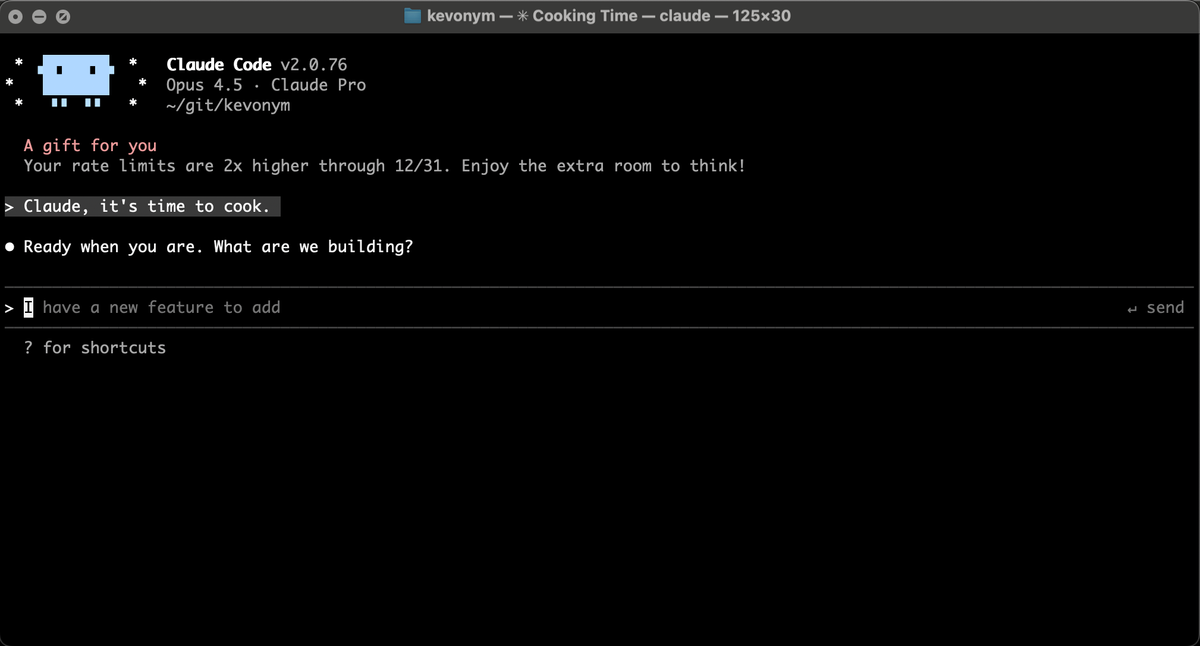
I launched kevonym.com on Christmas Eve, and it is bringing joy to the masses[1].
This is a turning point in my relationship with generative AI, or agentic coding tools, in particular. I've gone from skeptic to hesitant believer in fairly quick time, so this post serves as a brief overview of where I've been and what now works for me in this new software development paradigm.
Background
Last year, I started working on kevonym.com as a part-joke, part-exploration-of technology. I was interested in exploring Ktor[2]. as a JVM networking framework, with an additional idea to explore sharing Kotlin-defined models between server and client code. After getting a good chunk of the base CRUD API functionality built, it fizzled as many side projects do.
kevonym.com, as mentioned, is at least partially a joke. Replacing bits of words/phrases with "Kev" or "Kevin" is a pastime I employ with close friends, and a simple site to display and potentially notify friends of new ones seemed like...fun? Not enough fun to fully build out, though...until I had some help.
Generative AI: a love/hate story
Since ChatGPT emerged in 2022, I have served as the LLM-naysayer in any room I find myself. This stems, in part, from an (un)healthy distrust of The Next Big Thing™[3]
Anecdotal reports from colleagues indicated to me that Github Co-pilot, ChatGPT and so on only had utility in narrow use cases. Usage was being pushed heavily week-to-week in my corporate environment. And of course, the environmental and civic concerns [4][5] weighed (and continue to weigh) on me.
But then something unexpected happened.
I suddenly started hearing from colleagues that Claude Code was a different experience for AI-assisted coding. There was no consensus for the "right way" to use a coding agent like this, but almost daily I was hearing or reading about new workflows that Actually Worked, time that was saved, or to summarize: joy. I decided to give it a whirl.
Since November, I have been using Claude Code on two fronts:
- In my professional work, to create scripts and automation that help me in my job as an engineering leader
- In my personal work, exploring agentic coding workflows while building fun or weird stuff for the internet
Claude Code has been revelatory for me.
Actually building software with an agent
With Claude Code, I was rapidly able to build out an overbuilt web frontend for my overbuilt joke website. I'll post more going forward about what works for me in building software while pairing with Claude, but for now I'll summarize:
- Screaming architecture[6] is the lines that your agent will color within
- Build verification into your workflow (pre-commit hooks, define definition of done clearly)
- Plan Mode is the Way, the Truth, and the Light
The first two points are just as valid when working on a team as when working with an agent. The last point is an agent-specific (Claude Code-specific?) detail.
Wrapping up
I don't want to breeze by the aforementioned environmental or civic concerns, but for now I guess I will. The energy and water consumption required for LLM datacenters is perhaps grotesque. While knowing this, agentic coding feels magical and feels like it has unlocked latent creativity for me. I don't know how to reconcile any of this as an individual, and endorsing use of these technologies makes me uncomfortable. But here we are, in a world where individual consumption choices have little bearing on global outcomes.
The tooling, at least in the case of Claude Code, rocks. The paradigm of agentic coding is a sea change for software development. The ecosystem continues to shift monthly or weekly. I feel somewhat obligated to stay dialed into what the future holds, and I maintain a small degree of hope that the utility provided by these tools can be matched by resource efficiency improvements.
I'll post smaller blurbs about specific strategies for using coding agents (probably just Claude Code) in short order. Thanks for reading!
30 users in a week! ↩︎
see: blockchain ↩︎
https://news.mit.edu/2025/explained-generative-ai-environmental-impact-0117 ↩︎
https://www.michiganpublic.org/politics-government/2025-12-02/saline-residents-protest-data-center-project-chant-no-secret-deals ↩︎
https://blog.cleancoder.com/uncle-bob/2011/09/30/Screaming-Architecture.html ↩︎